When homework struggles are really working-memory struggles
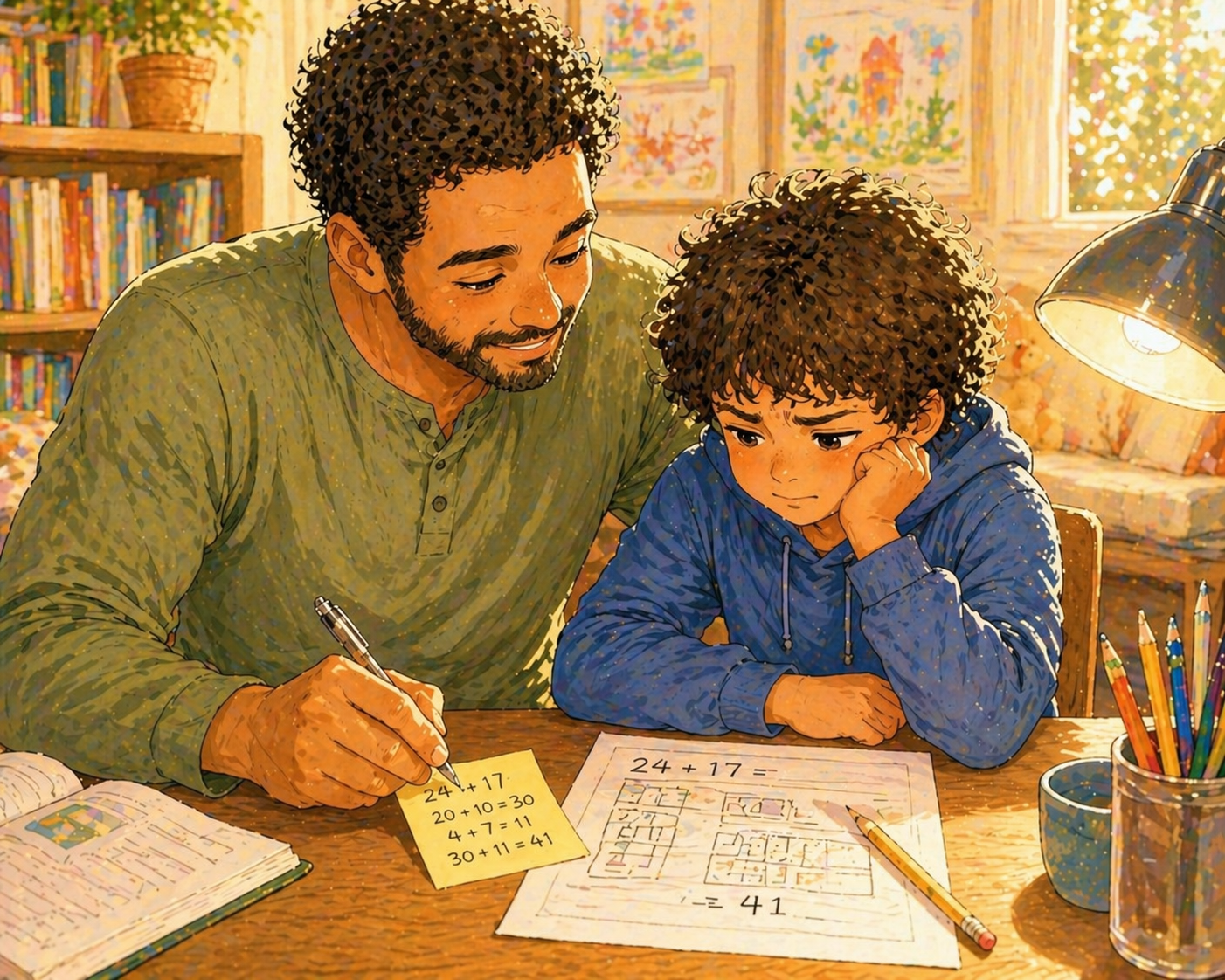
It's a familiar scene: a child sits down to do homework and seems completely capable of the individual pieces but keeps falling apart on the whole thing. They understand how to carry in addition when you show them, but twenty minutes later they're doing it wrong again. They read the multi-step problem out loud, correctly — and then solve only the first step. You ask what you said three minutes ago and they genuinely don't know. They're not distracted. They're not being difficult. They're working hard. But something keeps slipping.
This can look like an attention problem. Sometimes it is. But sometimes what's going on underneath is a working memory challenge — and the difference matters, because the tactics that help are somewhat different.
A note upfront: this post is not a clinical guide, and nothing here should substitute for a conversation with your child's teacher, a school psychologist, or a pediatrician if you have genuine concerns. What follows is a parent-level description of some signs and some general strategies — offered in the spirit of giving you useful language, not a diagnosis.
What working memory is and why it matters for homework
Working memory is the mental workspace where you hold information while you're actively using it. It's not long-term storage. It's the short-term, active holding: the number you're keeping in your head while you carry it in a math problem, the beginning of the sentence while you're reading the end, the three-step instruction while you're completing step two.
For homework, working memory is the infrastructure. Almost every school task draws on it:
- Multi-step math problems require holding earlier steps while executing later ones.
- Writing a paragraph requires holding the sentence you're forming while keeping the larger point in mind.
- Reading comprehension requires holding earlier sentences while processing new ones.
- Following a set of instructions requires holding all the steps in mind at once.
When working memory capacity is limited relative to the task demand, a child may understand the task, know the rules, and genuinely want to do it correctly — and still lose information partway through. It's not a knowledge gap; it's a capacity gap in the moment.
Signs that suggest working memory may be part of the picture
These are patterns, not proof of anything. But they're worth noticing:
Forgets multi-step instructions partway through. You say "Get your backpack, put your homework in it, and bring it to the table." The child gets the backpack but doesn't put the homework in, or does both but then wanders off before the third step. This is different from general distractibility — it's specifically the sequence that drops.
Can recite the rule but can't apply it under pressure. They can tell you what to do when you need to carry. Then they do the next problem and forget to carry. This suggests the rule is stored but applying it while simultaneously doing the calculation exceeds available working memory bandwidth.
Loses track in the middle of multi-step word problems. They solve part of the problem correctly, then either stop or solve a simpler problem than the one asked. The latter part requires holding the first part in mind while doing new work — that's working memory.
Re-reads or re-asks frequently. A child who repeatedly asks "Wait, what were we doing?" or re-reads the same line may be compensating for information that keeps dropping out of their working memory buffer.
Gets more tired on cognitively demanding tasks than peers seem to. When a child is working harder than usual to maintain information in mind, cognitive fatigue arrives earlier.
Working memory vs. attention: how they overlap and differ
Working memory struggles and attention struggles can look similar from the outside. The rough distinction: attention difficulties tend to be about what the child focuses on. Working memory difficulties tend to be about holding onto information once you're focused — the child is paying attention, but the information isn't staying where it needs to stay.
In practice, they often co-occur, and a given child may have elements of both. If you're seeing persistent patterns, your child's teacher is a useful first conversation — they see many children and have a calibrated sense of what's typical for the age group.
Tactics that may help at home
Write multi-step instructions down. Externalizing the steps removes the burden of holding them in working memory. A sticky note with the steps right on the desk can free up capacity for the actual task.
Chunk problems. Instead of presenting a page of ten problems, cover all but two. Complete those, take a breath, uncover the next two. Breaking the visual task down reduces cognitive load and can help a child sustain performance longer.
Read problems out loud together. Speaking and hearing the problem activates an additional memory channel alongside the visual one, which can help the child hold the information more stably while working with it.
Allow reference sheets for rules. If a child understands a procedure but keeps forgetting the step order, a reference card means they're not spending working memory on step recall — they can spend it on the actual work.
Build in deliberate breaks. Working memory fatigues. A five-minute physical break every 20–25 minutes is more effective than pushing through for an hour straight.
Play with short sequence tasks for fun. Light, non-homework practice with sequence games — card matching, clapping games, or a digital sequence game — provides low-stakes working memory exercise that doesn't carry the pressure of school performance.
A realistic view
Not every homework struggle is a working memory struggle. Kids have bad days. Some topics are genuinely hard. Some children resist homework for reasons that have nothing to do with capacity. The patterns above are signals worth noticing if they're persistent and consistent — showing up day after day across different tasks — rather than occasional.
If you do notice persistent patterns, the most useful step is usually a conversation with the teacher, who can tell you whether they're seeing the same things in the classroom and can connect you with the right school resources if a deeper look seems warranted.
In the meantime, small environmental adjustments — writing things down, chunking tasks, building in breaks — cost nothing and often make a meaningful difference.
If you want a simple way to practice these skills, try Just Repeat After Me! on the App Store. Available in English and Spanish.