Why kids love "repeat after me" games — and the science of why imitation teaches
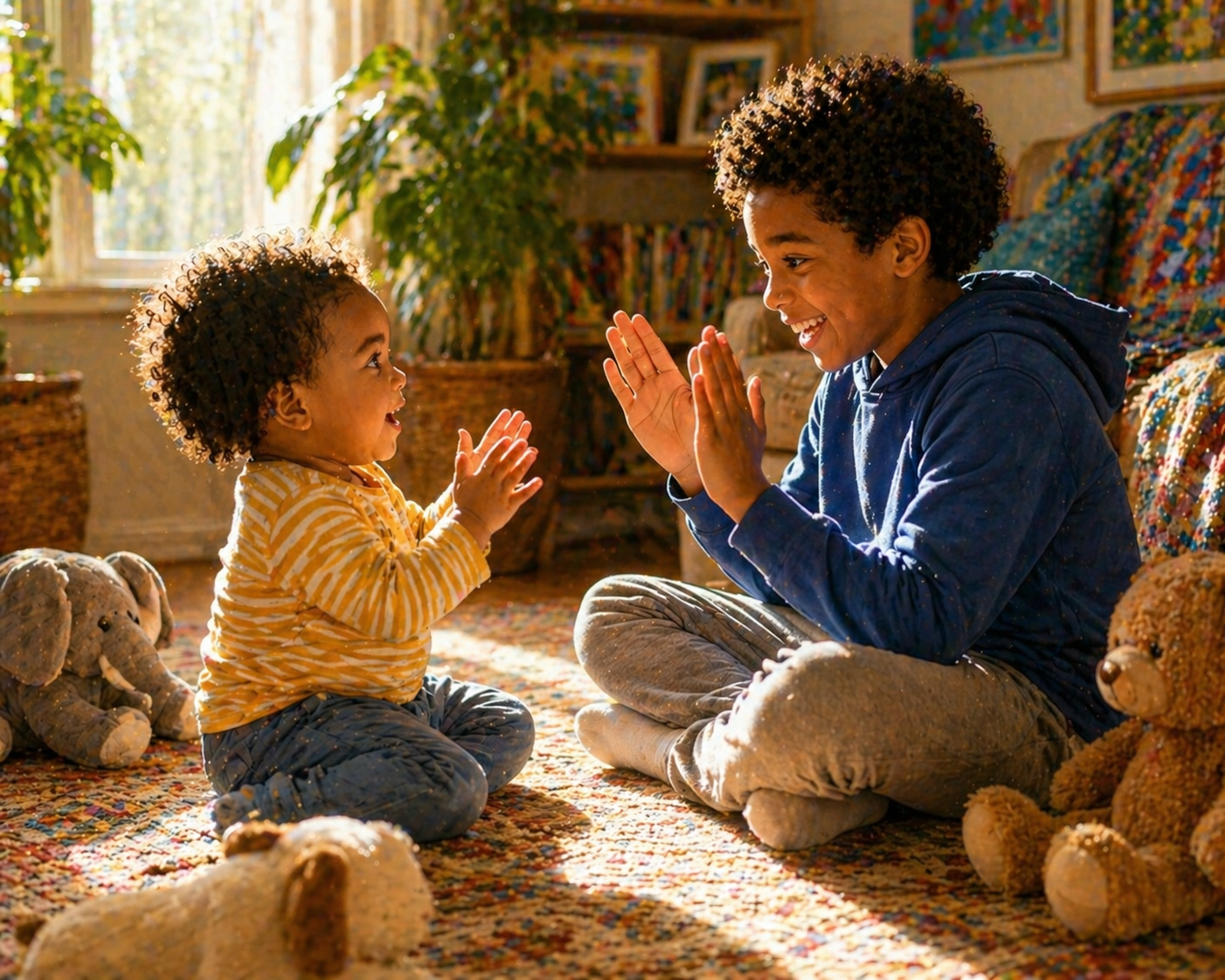
Watch a toddler carefully for an afternoon. They will imitate almost everything — a phrase you used two days ago, the way you stir a pot, the particular laugh of a sibling. They do this before they can read, before they can reason abstractly, before they can do much of anything that looks like formal learning. Imitation comes first.
This isn't an accident. It's a foundational learning mechanism — one of the earliest and most powerful ways the brain acquires skills, language, and knowledge. And "repeat after me" games, at every age from toddler to school-age and beyond, are tapping into this mechanism directly.
Mirror neurons and the biology of imitation
In the early 1990s, researchers studying motor neurons in macaque monkeys noticed something surprising: certain neurons fired not only when the monkey performed an action, but also when it watched someone else perform the same action. The brain was, in some sense, simulating the observed action from the inside.
These became known as mirror neurons, and subsequent research suggested that humans have an analogous system — a distributed network of brain regions that activates both during action and during the observation of action in others.
The science here is still actively debated and more complex than the popular summary version suggests. Mirror neurons are not a simple "I see it, therefore I can do it" system. But the broader finding — that observation and imitation share neural architecture — helps explain something parents observe all the time: children learn the shape of a skill by watching it closely, and they consolidate that learning by doing it themselves.
"Repeat after me" games are a formalized version of this loop. Watch me do something. Now you do it. The game creates a structured cycle of observation and output.
Learning by output: why you remember what you actively produce
There's a well-documented phenomenon in memory research sometimes called the "generation effect": information you actively produce — say aloud, write down, or actively recall — is remembered better than information you passively receive.
The reason has to do with encoding depth. When you generate information from memory rather than simply reading it or hearing it, you engage more cognitive resources, make more connections to existing knowledge, and create a richer, more retrievable memory trace. The act of production itself strengthens the encoding.
This is why flashcards work better when you attempt the answer before flipping the card. It's why summarizing what you just read is more effective than re-reading it. And it's why "repeat after me" games produce stronger learning than observation alone.
For a child in a music lesson who echoes a phrase back to the teacher, the echo isn't just showing that they heard it. The act of producing it — even imperfectly — is part of how the phrase gets encoded. For a child playing a sequence game who tries to reproduce a pattern of colors and sounds, the attempt itself is doing cognitive work, whether or not it succeeds on the first try.
Why "again, again!" is a learning signal
Every parent knows the request. The book ends, the song finishes, the game round is over — and the child says "again, again!" with the particular urgency of someone who is not done yet.
It's easy to hear this as entertainment-seeking. And sometimes it is. But there's a learning dimension too: repetition in early childhood is often the brain signaling that it hasn't finished processing yet.
When a child hears a story multiple times, they notice different things on each pass. On the first hearing, they get the surface narrative. On the second, they might notice a detail they missed. On the third, they might start to anticipate events and feel satisfied when the prediction is correct. Each pass is doing different cognitive work.
The same applies to "repeat after me" games. The first attempt at a sequence might fail. The second attempt might succeed partially. The third might succeed fully and feel genuinely satisfying. The repetition isn't redundancy — it's the learning cycle completing itself.
"Again, again!" is often worth saying yes to.
The particular power of paired sound-and-color sequences
When a "repeat after me" game pairs visual information with audio information — when each element in the sequence has both a color and a distinct tone — the encoding task becomes richer. The child has to form a binding: this color goes with this sound. The sequence must be held in both channels simultaneously.
This is harder than either color-only or sound-only, but in a productive way. The dual encoding creates two retrieval pathways for the same information. If the visual memory of the sequence is fuzzy, the auditory memory may support it. If the sound is forgotten, the color may bring it back. The redundancy across channels is what makes the binding durable.
It's also why auditory-visual sequence games engage children who might lose interest in purely visual pattern games. The sounds make the sequences more distinctive — more memorable, more interesting to reproduce.
From ancient pedagogy to touchscreens
The "repeat after me" structure isn't new. It's one of the oldest documented teaching methods in human history: the teacher does, the student echoes, the teacher does more, the student echoes more. It appears in oral traditions, music apprenticeships, language learning, and early childhood education across cultures and centuries.
What's interesting about a game like Just Repeat After Me is that it's a solo implementation of a fundamentally relational mechanic. The game plays the teacher role — lighting up a sequence, waiting, accepting or declining the response — while the player plays the student role. The ancient call-and-response loop, translated into a seven-level leveled challenge with a unique sound per button and a Game Center leaderboard for when the sequences get long enough to brag about.
The mechanism underneath is the same one that drove echo exercises in a Suzuki violin lesson, in a language immersion classroom, in a grandmother teaching a grandchild a clapping game. Imitate. Reproduce. Encode. Again.
If you want a simple way to practice these skills, try Just Repeat After Me! on the App Store. Available in English and Spanish.