Family game night with a brain-training twist: 5 games, 30 minutes
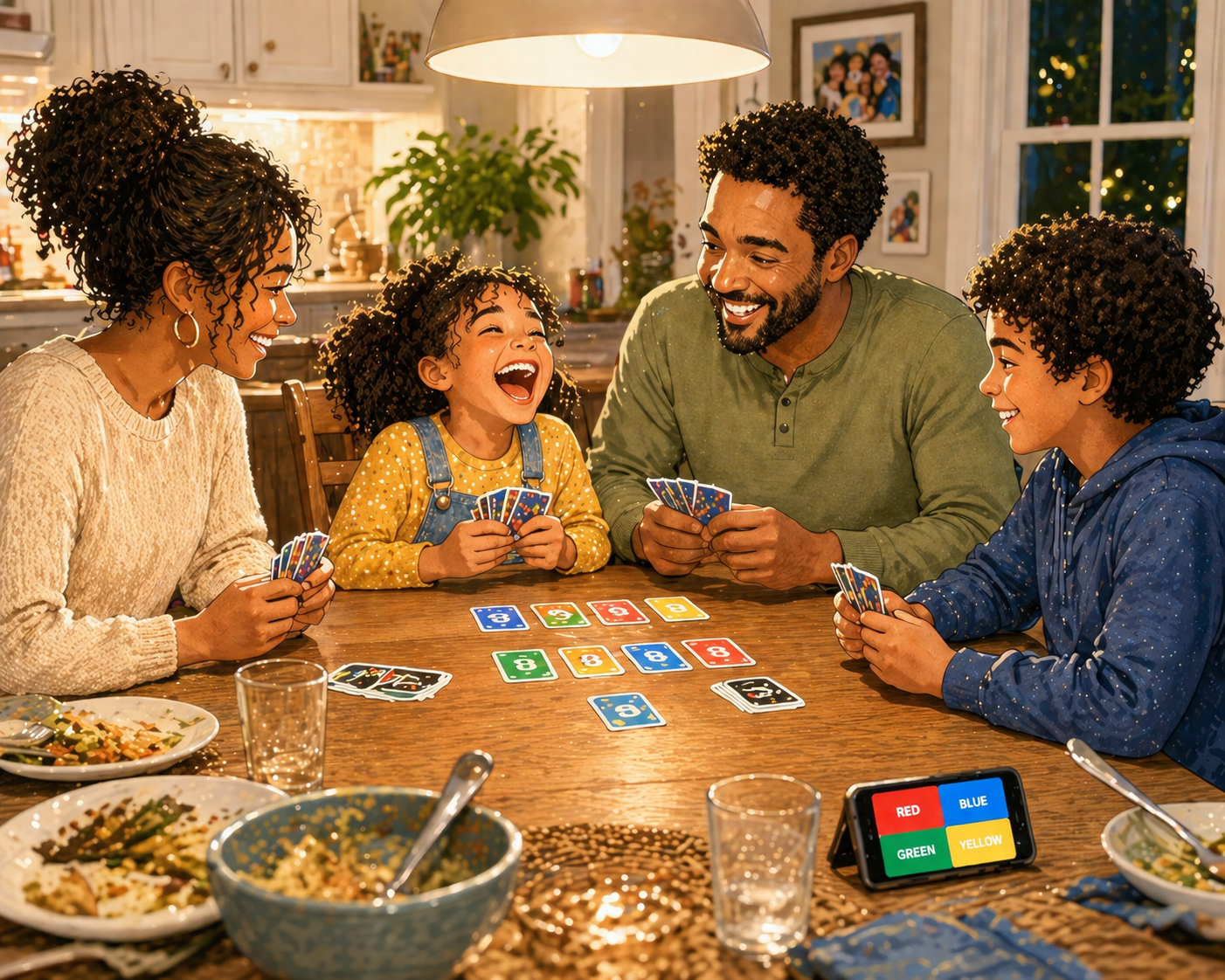
A full board game setup takes time, negotiation, and about twenty minutes of cleanup. That's fine on a Saturday. But a weeknight version of family game night — something that fits between dinner and bedtime — calls for a different kind of structure.
Here's a rotation that works: five games, roughly six minutes each, thirty minutes total. The games below require almost no setup, no scoreboards except the ones in your head, and can be adjusted for a wide range of ages. Each one is genuinely good for working memory and attention — though that's a side effect of them being engaging, not the point.
The rotation
Game 1 (minutes 0–6): Card matching sprint
Pull out a standard deck of cards, or a memory matching set if you have one. Use about twenty cards (ten pairs) for a quick version. Lay them face-down. Flip two at a time; if they match, you keep them. Take turns until the board is cleared.
The brain-training angle: Each card you flip is a clue you need to hold — where it was and what it showed. As the game progresses, the player who can hold more of the board in mind has a genuine advantage. It's working memory applied to something that feels competitive rather than educational.
Age adjustment: Let younger players use fewer cards (eight is fine for ages 4–5). Older players can time themselves to beat a personal clearing record.
Game 2 (minutes 6–12): "I went to the moon and brought..."
Classic cumulative memory chain. Start with one item, add one per turn, and the sequence grows until someone forgets.
"I went to the moon and brought a flashlight." "I went to the moon and brought a flashlight and a purple sock." "I went to the moon and brought a flashlight, a purple sock, and a very small dog."
The brain-training angle: Holding an ordered list that keeps growing is a clean sequence-memory task. The round ends when someone forgets, then you just start again. The "again, again" quality is part of what makes it good.
Tips: Let young children hold fewer items with no embarrassment — cheer when the four-year-old holds three items just as you cheer when the ten-year-old holds eight.
Game 3 (minutes 12–18): Word association chain with a memory catch
Works well for ages 7 and up. The first person says a word. The next person says a word associated with it. The chain continues. The memory catch: every three turns, someone must recite the full chain back from the beginning.
The brain-training angle: Association chains are easy to extend; recalling them in order is harder. The regular interrupt keeps working memory in active use throughout, rather than just at the end.
Age adjustment: For younger children, skip the recall requirement and just play the association game. For older children, extend the recall interval to every five turns.
Game 4 (minutes 18–24): Telephone (two-person precision version)
One person composes a sentence with specific details: numbers, colors, proper names, unusual words. "The three yellow frogs visited Madagascar on a Thursday and ate twelve pomegranates." The other person must wait sixty seconds — no writing — and then repeat it back as precisely as possible. Switch roles.
The brain-training angle: Holding highly specific, arbitrary information across a time delay is a direct working-memory challenge. The details are designed to be unmemorable, which is exactly the point.
Game 5 (minutes 24–30): Just Repeat After Me — device-to-device round
Pass a phone, tablet, or Mac around the table. Each player opens Just Repeat After Me, attempts to complete one sequence at whatever level they're playing, and hands the device to the next player. No pressure to continue if the sequence fails — just try, see what happens, pass it on.
The brain-training angle: The game presents a sequence of colored buttons, each with a distinct tone. The player watches and listens, then reproduces the sequence. Sequences grow with each success. The hand-off format keeps the round moving quickly, and different players will naturally be at different points in difficulty — which makes it interesting to watch rather than boring to wait through.
Setup note: One device is enough. If you have multiple devices, each player can track their own personal best across sessions.
A few notes on running the rotation
You don't have to do all five. Three games from the list works too. The point isn't the full thirty minutes — it's building a regular rhythm of playing with memory tasks together, which is more valuable than any single session.
Keep the tone playful rather than evaluative. When someone forgets in the moon game or drops the word chain, the right energy is "let's try again" rather than "you should have remembered." The moment it feels like a test, the memory performance actually gets worse — low-stakes practice is genuinely more effective than high-pressure performance.
And the games rotate naturally: when the card matching gets old, swap in Kim's Game. When the word chain gets stale, try a number sequence version instead. The mechanic stays the same; the novelty keeps it engaging.
If you want a simple way to practice these skills, try Just Repeat After Me! on the App Store. Available in English and Spanish.