Screen-free memory games for kids — plus one screen game worth the exception
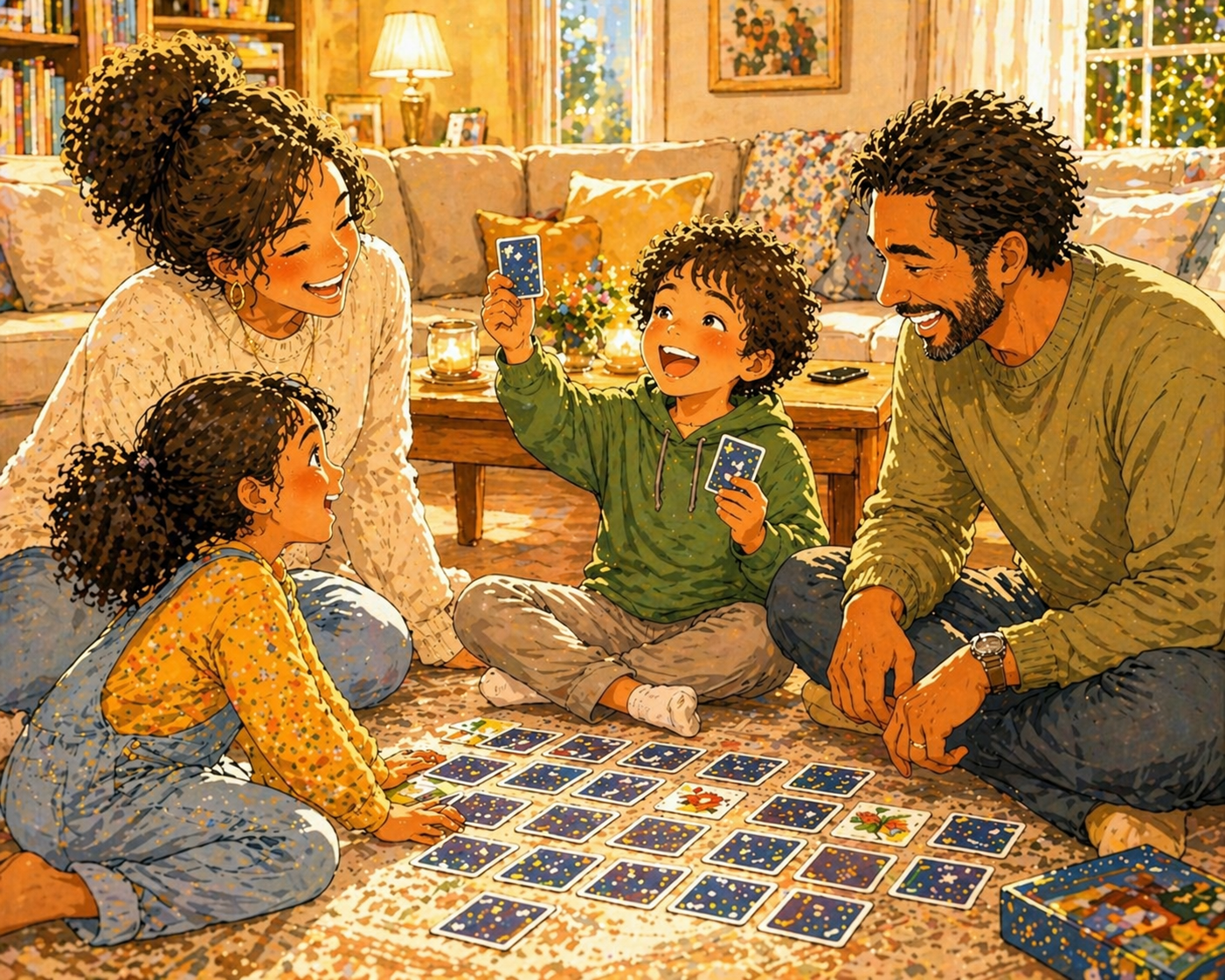
You don't need a screen to give your child a memory workout. Most of the best memory games for kids cost nothing, require no setup, and can happen anywhere — in the car, at the dinner table, in a waiting room, or on a rainy afternoon. The classics work because they were designed (or discovered by generations of kids) to be genuinely engaging, not just educational in theory.
Here's a list of eight screen-free options worth knowing, followed by an honest word about what to look for if you do want to bring a screen into the mix.
Eight screen-free memory games kids actually love
1. Memory (concentration card matching)
Two face-down cards get flipped at a time; find the matching pair and keep them. The mechanic is pure working memory: you're holding the location of every unmatched card in mind, updating the picture as new cards are revealed.
Works from around age 4 up. For younger kids, use fewer cards. For older kids, use a full deck and see how fast they can clear it solo.
2. "I went to the moon and brought..."
A classic cumulative memory game. The first player says "I went to the moon and brought a telescope." The next player repeats it and adds something. "I went to the moon and brought a telescope and a sandwich." And on it goes. The sequence grows until someone forgets.
The beautiful thing about this one is that it naturally creates a little pressure — not the bad kind, but the motivating kind — and kids almost always want to try again immediately after a mistake.
3. Kim's Game
Place 10–15 small objects on a tray. Let the child study them for one minute. Cover the tray. Ask: what can you remember? Or remove one item while covered, then uncover and ask: what's missing?
Named for the novel by Rudyard Kipling, used in scouting programs for over a century. Works beautifully for ages 5 and up and is one of the few pure visual memory exercises you can do without any materials beyond household objects.
4. Simon Says (the original version)
Before electronic games, Simon Says was a listening-and-following game. "Simon says clap twice, jump, spin left." Following multi-step verbal instructions while filtering for whether Simon actually said so — that's attention and working memory working together.
Worth noting: this is a direct ancestor of color-sequence games. The core mechanic — watch, remember, reproduce — has been at the heart of memory games for a long time.
5. Song-and-clap patterns
Take any song your child knows and replace some words with claps. Then build a clapping pattern alongside a melody, and ask the child to echo it back.
This one activates both auditory memory and rhythm processing. It's particularly effective because children often find it funny, which lowers self-consciousness about making mistakes.
6. Telephone
The old-fashioned version: whisper a sentence down a line of people and see what emerges at the end. For a two-person version, one person says a sentence with specific details, the other repeats it back as precisely as possible after a 30-second delay.
7. Story retell
After reading a book or finishing a movie, ask: "Can you tell me what happened — start to finish?" Story retelling is a surprisingly powerful working-memory exercise because it requires sequencing, selection, and recall all at once.
For younger children, you can take turns — you say the first part, they say the next. For older children, try asking them to retell without prompting and see how much detail they can hold.
8. Twenty Questions (in reverse)
Standard twenty questions asks one person to guess what another is thinking. The memory twist: after the game, ask the guesser to reconstruct all twenty questions in order. It's harder than it sounds, and kids find the challenge surprisingly motivating.
If you're going to make a screen exception
All of the above games are worthwhile on their own. But there are moments — long car rides, sick days, the five minutes before a sibling's lesson ends — when a screen game is simply what's available. The question then isn't "screen or no screen?" but "what should I actually be looking for?"
Here's what separates a screen game worth the exception from one that isn't:
- Sound-pattern feedback. Games that use both audio and visual information to carry the sequence ask the brain to do more integrative work than visual-only games.
- No reward loops unconnected to skill. Spinning wheels, daily bonus coins, and mystery-box reveals are designed to keep a player in the game regardless of whether they're learning anything.
- No ads, especially not in a children's context.
- Difficulty that grows with the player. A sequence-memory game that stays at the same length forever is entertainment, not practice.
- No time-pressure that overrides memory work. For younger children especially, artificial time pressure can collapse the memory task into a stress response.
Just Repeat After Me is a clean example of this mechanic done right: colored buttons light up in sequence, each with a unique tone, and the player has to reproduce the sequence in order. Seven levels of difficulty, leveled freemium (the first three levels are free), no ads, no rotating reward systems, and no data collection. It's essentially a modern, screen-based version of the same mechanic that Kim's Game and song-and-clap patterns and Simon Says have been using for generations. The screen is the medium, not the point.
Use it when it's the right tool. Use the list above when it isn't.
If you want a simple way to practice these skills, try Just Repeat After Me! on the App Store. Available in English and Spanish.