How music-based games boost memory in children
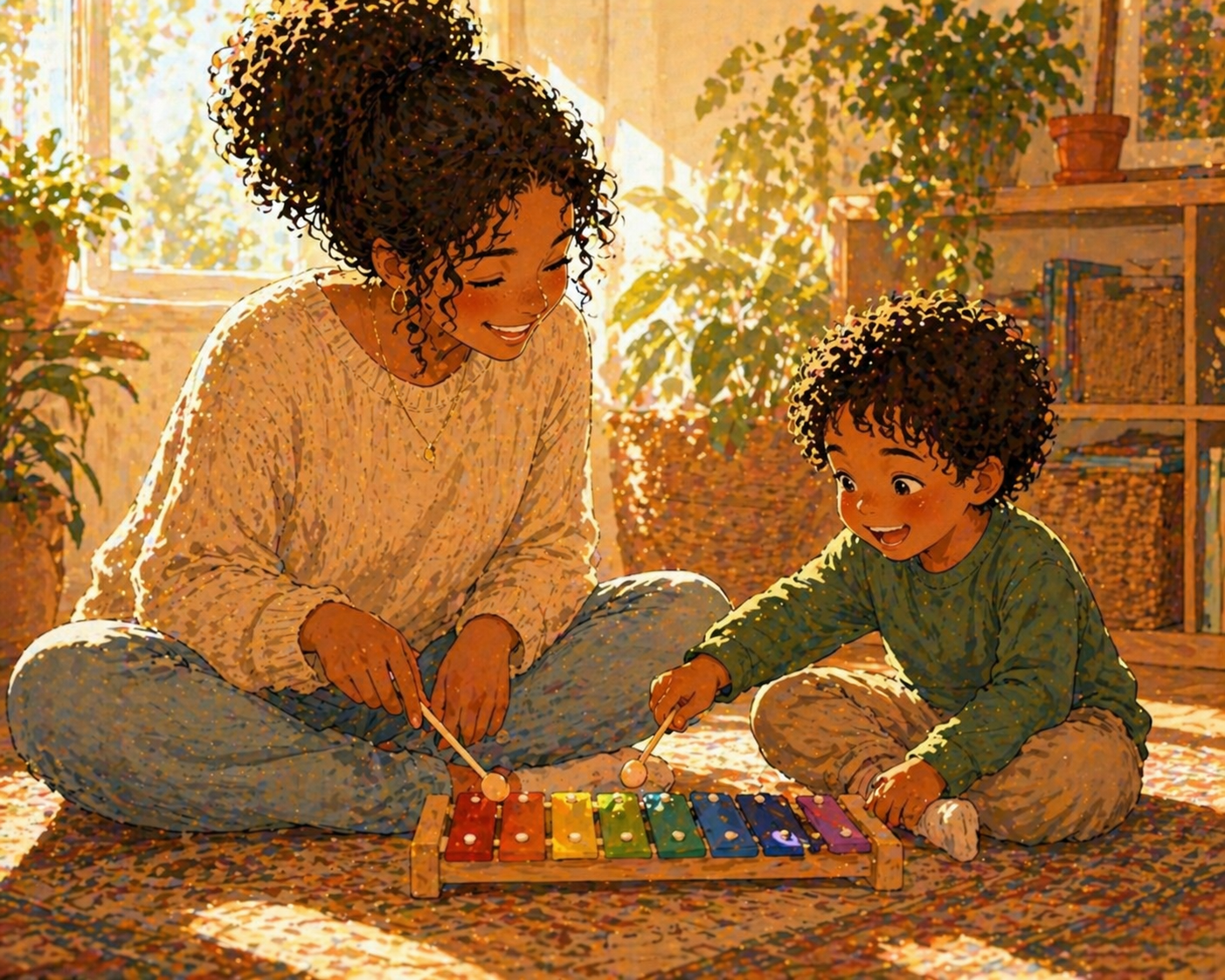
There's a reason children's songs have verses that repeat. A reason the alphabet is sung rather than recited flat. A reason music teachers in every tradition, on every instrument, ask students to echo phrases back before they ever read a note. Music is extraordinarily good at getting things to stick — and the mechanism behind that is auditory sequencing, which turns out to be one of the most effective on-ramps to working memory development in children.
What auditory sequencing means
Sequencing, in a cognitive sense, is the ability to hold and process information in a specific order. You use it when you follow directions, recall a story in the right order, solve a multi-step math problem, or remember a phone number long enough to dial it.
Auditory sequencing specifically refers to doing this with sound. It's the ability to hear a sequence of sounds — words, tones, rhythms — hold them in the right order, and either retrieve them later or reproduce them immediately.
Research in cognitive development suggests that the auditory channel is particularly well-suited for sequential memory tasks. There's a phenomenon sometimes called the "phonological loop" — part of working memory that seems specifically designed to rehearse and hold sound-based information. When children engage with sound sequences, they're exercising exactly this capacity.
Why hearing-and-repeating is different from reading-and-repeating
Most school-based learning leans heavily on visual and verbal-linguistic modes: reading instructions, looking at diagrams, writing responses. These are valuable, but they activate a somewhat different memory pathway than hearing-and-reproducing does.
When a child reads a list and tries to memorize it, they're primarily using visual working memory and a strategy called rehearsal — re-reading to keep the information active. When a child hears a musical phrase and repeats it, they have to hold the auditory trace in mind just long enough to reproduce it, which forces active engagement with the sequence at a finer grain.
The reproduction piece is key. Studies in music cognition have found that active output — singing it, clapping it, playing it back — produces stronger encoding than passive listening. It's the act of generating the sequence from memory, rather than simply recognizing it when prompted, that drives encoding depth.
This is why echo games in music education are so persistent across methods and cultures. They're not just a warm-up. They're one of the most efficient encoding tools available.
Clap-back games: the simplest form
The most accessible version of auditory sequencing practice is a clapping game. One person claps a rhythm; the other echoes it back exactly. No materials. No setup.
For children around ages 4–6, start short: two or three claps with a pause. For ages 7 and up, you can build rhythms that include varying tempos, syncopation, or rests. The cognitive work is the same throughout: hear it, hold it, reproduce it.
"Name that tune" with a twist
Here's a variation that blends auditory memory with pattern recognition: hum the first few notes of a song your child knows well, then stop. Ask them to hum the next few notes. Then you continue. Go back and forth.
What you're building here is not just recognition (do you know this song?) but anticipatory sequencing (what comes next in the pattern?). Children who regularly play with music this way develop a stronger sense of how musical phrases are structured, which is a specific form of sequential pattern awareness.
Recorder echo and beginner instrument practice
If your child plays an instrument — recorder, ukulele, piano, anything — echo practice is one of the most effective ways to develop both technique and memory simultaneously.
Play a short phrase. Ask them to play it back. Not from the sheet music; from what they heard. Then extend the phrase by one note and ask again.
You don't have to be a musician to do this. On a recorder or a simple xylophone, you can play a sequence of three or four notes without knowing music theory. The child's job is to listen, remember, and reproduce. The instrument just makes the listening more precise because each note has a distinct pitch.
This is also why Just Repeat After Me works the way it does: each colored button has a unique tone, and sequences must be tracked by both color and sound together. A child who plays the game is doing auditory-visual sequencing — binding the color to the tone in memory and holding the paired sequence in working order. That's a richer encoding task than color-only or sound-only versions.
Why the audio component matters for screens specifically
There are plenty of sequence-memory games designed for children that use only visual cues — match the pattern of lights, tap the squares in order. Those aren't without value, but they're missing the auditory component that seems to drive stronger encoding.
When both color and sound carry the sequence — when the red button always sounds like a specific tone, when the pattern is something you could hum as well as see — the brain has two independent channels to encode the sequence, and each reinforces the other. This dual-channel encoding is one reason music-based games tend to be stickier than pure visual pattern games.
An everyday practice routine
You don't need instruments or apps to build this. A simple rotation:
- In the car: clap a rhythm, ask for an echo. Alternate who leads.
- At dinner: hum a few notes of a familiar song, ask what comes next.
- Before bed: read a story, then ask the child to retell the main events in order.
- Occasionally, with a screen: a clean sequence game that uses both sound and color — a few minutes, then put it down.
The goal is regular, low-stakes contact with the idea of sequences: hear them, hold them, produce them. That loop — across sound, speech, rhythm, and melody — is one of the more robust things you can give a young brain to work on.
If you want a simple way to practice these skills, try Just Repeat After Me! on the App Store. Available in English and Spanish.