Short-term memory milestones from ages 4 to 10 — and playful ways to strengthen each stage
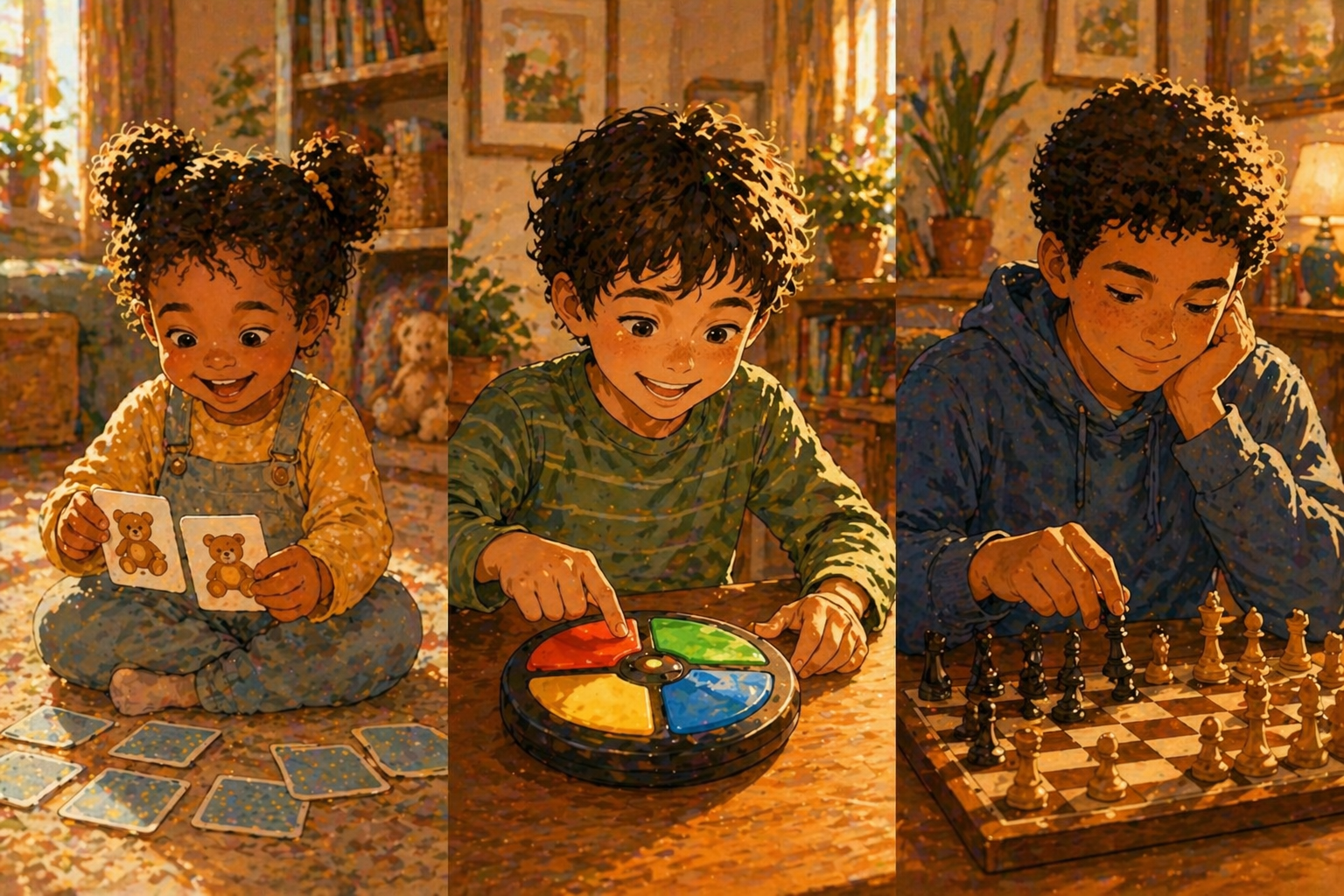
Working memory — the ability to hold and use information in the short term — doesn't arrive fully formed. It develops in stages, growing steadily throughout childhood and into early adolescence. Knowing roughly what to expect at each age can help parents choose activities that are appropriately challenging: not so easy that a child is bored, not so hard that the task collapses into frustration.
What follows is a practical guide to the main developmental stages from ages 4 to 10, with one or two game ideas for each. These aren't clinical benchmarks — if you have specific concerns about your child's development, your child's teacher or pediatrician is the right starting point. This is more about the general shape of how memory capacity grows, and how to give it something to work with at each stage.
Ages 4–5: two to three item sequences
At this age, most children can hold two to three items in working memory at once. They can follow a two-step instruction fairly reliably, though a third step often drops off.
What's developing here is the basic capacity to hold and sequence information — not just remember a single fact, but keep two or three facts in order and act on them.
Game idea: simple card matching
Memory (concentration) with a small set of cards — eight to ten cards, four to five pairs — is exactly right for this age. The child is holding the location of a small number of items in mind, updating as new cards are revealed. A simpler version: lay out just six cards, three pairs. Let them flip freely. The goal isn't winning; it's the act of holding and updating the mental map.
Game idea: two-step "I went to the moon"
Start the classic cumulative game but stop after two additions for 4-year-olds, three for 5-year-olds. Celebrate holding the sequence correctly rather than extending it far.
Ages 6–7: three to four item sequences and story retell
By age 6 or 7, most children can hold three to four items in sequence, follow three-step instructions with reasonable consistency, and retell a simple story with the main events in order.
Story retell is a particularly useful indicator: a child who can say "first this happened, then this, then this" is demonstrating both sequential memory and narrative structure — skills that matter for reading comprehension and early writing.
Game idea: story retell after reading
After reading a picture book together, ask: "Can you tell me what happened? Start at the beginning." Don't correct the order; just listen for how much the child holds. For 6-year-olds, try two-part retells first. For 7-year-olds, aim for three or four main events.
Game idea: three-step Simon Says
"Simon says: clap three times, turn around, and sit down." At this age, a three-step sequence is meaningful work. The game form keeps it light — the "did Simon say it?" filter adds a second layer of attention, making it richer than a straight instruction-following task.
Ages 8–9: five or more items and working backwards
This is a significant jump. Children around 8 and 9 start to hold five or more items in working memory, follow multi-step instructions without needing reminders, and begin to manipulate sequences in working memory rather than just holding them.
"Working backwards" tasks are a good marker of this stage: recite the months of the year backwards, say your phone number in reverse, recall events from the end of a story to the beginning. These tasks require not just holding the sequence but actively restructuring it — a more demanding use of working memory.
Game idea: backwards retell
After a movie or story, ask: "Start at the end. What was the last thing that happened? What happened before that?" Going backwards through a narrative requires the child to hold the whole structure in mind and traverse it in reverse — considerably harder than forward retelling.
Game idea: sequence games with five or more elements
This is the age where a pattern-recall game with growing sequences becomes genuinely engaging rather than too difficult. A game like Just Repeat After Me starts with gentle sequences and grows them — the first level or two are appropriate for younger players, but by levels 3 and 4, the sequences are long enough to challenge a well-developed 8 or 9 year old meaningfully.
Ages 10+: multi-step instructions and mental rotation
By age 10, working memory capacity is approaching adult levels in most children. Children at this stage can follow complex multi-step instructions, plan ahead in games and tasks, hold multiple variables in mind simultaneously, and begin to do what researchers call mental rotation: manipulating a mental image or sequence without physically acting it out.
Academically, this is when multi-step word problems in math start to feel tractable, when longer writing assignments become possible, and when reading comprehension can handle complex plots with multiple threads.
Game idea: strategy board games
Games like chess, checkers, or any game that requires holding "if I do this, then they might do that, then I could do this" are well-matched to this age. The working memory demand here isn't about holding a list — it's about holding a branching set of possibilities.
Game idea: harder sequence and pattern games
At this age, a pattern-recall game becomes a genuine personal challenge. Competing against a personal best score — "my longest sequence was 9, can I beat that?" — uses working memory and motivation together. Game Center leaderboards can add a social layer that older children often find energizing.
A note on individual variation
The age bands above are ranges, not rules. Some children will manage four-item sequences comfortably at age 5; others will find two-item sequences challenging at age 6. Neither is cause for concern on its own. Working memory capacity varies naturally, and it also varies day to day within the same child — tiredness, stress, hunger, and interest level all affect performance.
What matters more than hitting a benchmark is having regular, low-pressure practice with sequencing tasks that match roughly where the child is. Too easy and there's no challenge; too hard and the experience just feels bad. The sweet spot is one step beyond comfortable.
If you want a simple way to practice these skills, try Just Repeat After Me! on the App Store. Available in English and Spanish.